DEMOKRATİK SİSTEMLER İÇİN KÜRESEL BİR SİBER GÜVENLİK TEHDİDİ OLARAK YAPAY ZEKÂ DESTEKLİ DEZENFORMASYON
Anahtar Kelimeler:
Yapay Zeka Destekli Dezenformayon- Siber Güvenlik- Demokratik Sistemler- Bilişsel Güvenlik- Üretken Yapay ZekaÖzet
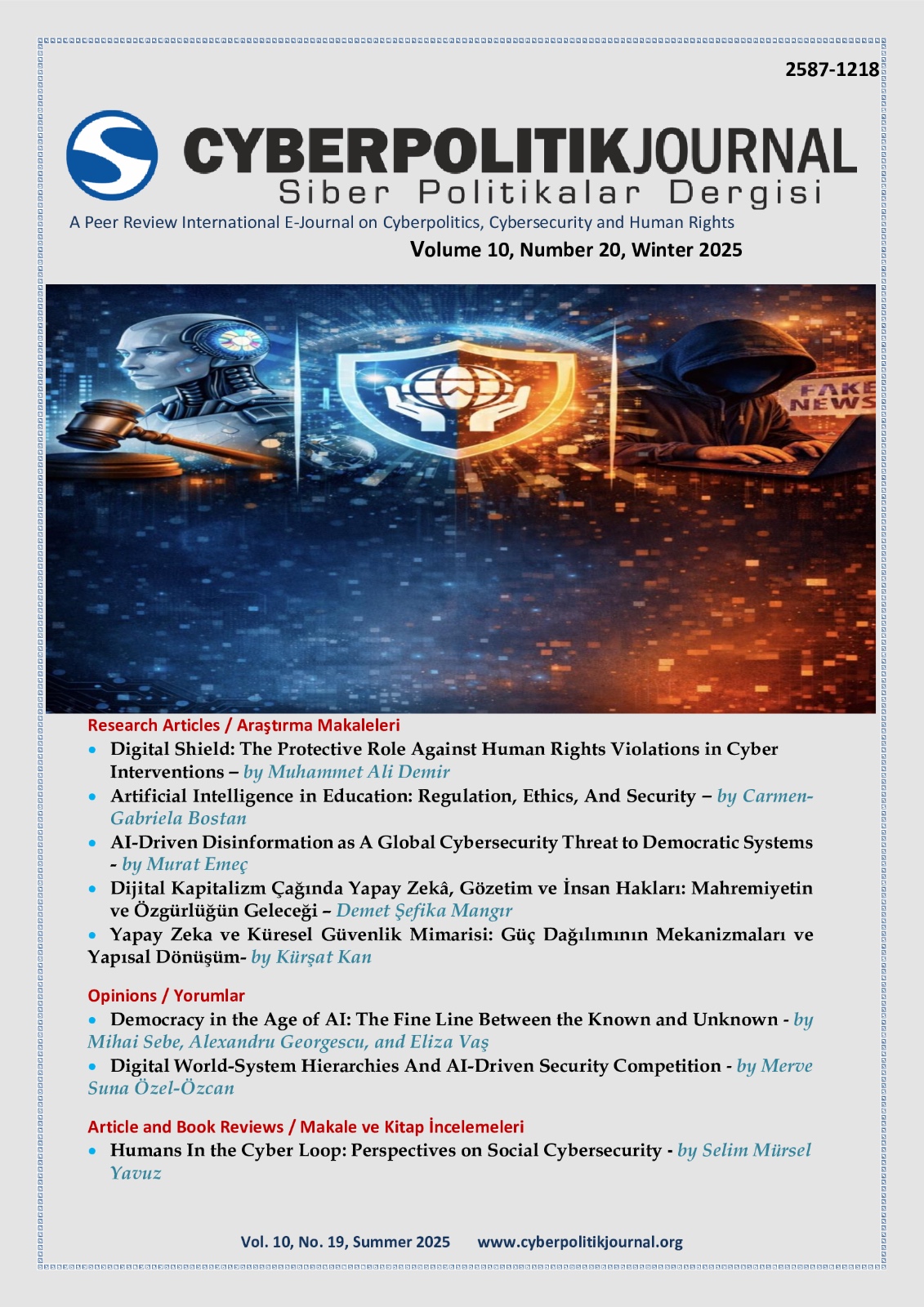
The proliferation of generative artificial intelligence has fundamentally transformed our current information landscape, facilitating the widespread production and consumption of photorealistic yet fictitious media. So, misinformation is no longer just a communication issue; it is an absolute cybersecurity threat, especially for democracies that depend on trust, transparency, and an informed public. This paper views AI-fueled disinformation as a cognitive cyber-attack aimed at modifying perceptions, shaping belief formation, and undermining the legitimacy of institutions, rather than solely targeting technical systems. Based on literature in cybersecurity, political communication, and AI governance, the research investigates how generative AI augments disinformation, which systemic failures in democracies it exploits, and why current interventions fall short. The results, he says, are that AI-supported disinformation damages public trust, increases social and political fragmentation, and distorts electoral and governmental processes in ways that are often hard to detect and even harder to put right. The research suggests expanding existing cybersecurity strategies to protect democracies in the age of generative AI by considering not only information integrity and cognitive security but also societal resilience to disinformation and propaganda, as well as technical protections.
Referanslar
Aditya, S. (2025). The misinformation epidemic: combating AI-generated fake content and deepfakes. World Journal of Advanced Research and Reviews. https://doi.org/10.30574/wjarr.2025.26.2.1752
Bennett, W. L. & Livingston, S. (2025). Platforms, Politics, and the Crisis of Democracy: Connective Action and the Rise of Illiberalism. Perspectives on Politics. https://doi.org/10.1017/s1537592724002123
Bienvenue, E. (2020). Computational propaganda: political parties, politicians, and political manipulation on social media. International Affairs. https://doi.org/10.1093/ia/iiaa018
Bontridder, N. & Poullet, Y. (2021). The role of artificial intelligence in disinformation. Data & Policy. https://doi.org/10.1017/dap.2021.20
Corsi, G., Marino, B., & Wong, W. (2024). The spread of synthetic media on X. Harvard Kennedy School Misinformation Review. https://doi.org/10.37016/mr-2020-140
Demartini, G., Mizzaro, S., & Spina, D. (2020). Human-in-the-loop Artificial Intelligence for Fighting Online Misinformation: Challenges and Opportunities. IEEE Data Eng. https://consensus.app/papers/humanintheloop-artificial-intelligence-for-fighting-demartini-mizzaro/6fe75dfbff
Drolsbach, C. & Pröllochs, N. (2025). Characterising AI-Generated Misinformation on Social Media. ArXiv. https://doi.org/10.48550/arxiv.2505.10266
Imam, M. (2025). The Threats of AI and Disinformation in Times of Global Crises. Bulletin of Islamic Research. https://doi.org/10.69526/bir.v3i4.394
Jaidka, K., Chen, T., Chesterman, S., Hsu, W., Kan, M., Kankanhalli, M., Lee, M., Seres, G., Sim, T., Taeihagh, A., Tung, A., Xiao, X., & Yue, A. (2024). Misinformation, Disinformation, and Generative AI: Implications for Perception and Policy. Digital Government: Research and Practice.
Kaczmarek, K., Karpiuk, M., & Melchior, C. (2025). Disinformation as a Threat to State Security. Przegląd Nauk o Obronności. https://doi.org/10.37055/pno/205780
Kreps, S. E. & Kriner, D. (2023). How AI Threatens Democracy. Journal of Democracy. https://doi.org/10.1353/jod.2023.a907693
Lorenz-Spreen, P., Oswald, L., Lewandowsky, S., & Hertwig, R. (2022). A systematic review of worldwide causal and correlational evidence on digital media and democracy. Nature Human Behaviour. https://doi.org/10.1038/s41562-022-01460-1
MacDonald, E. (2025). Digital Authoritarianism and the Erosion of Democratic Norms: A Comparative Study of State Surveillance in Hybrid Regimes. OTS Canadian Journal. https://doi.org/10.58840/2an15325
Marsden, C., Brown, I., & Veale, M. (2021). Responding to Disinformation. Regulating Big Tech. https://doi.org/10.1093/oso/9780197616093.003.0012
Mazurczyk, W., Lee, D., & Vlachos, A. (2023). Disinformation 2.0 in the Age of AI: A Cybersecurity Perspective. Communications of the ACM. https://doi.org/10.1145/3624721
Miller, M. L. & Vaccari, C. (2020). Digital Threats to Democracy: Comparative Lessons and Possible Remedies. The International Journal of Press/Politics. https://doi.org/10.1177/1940161220922323
Mirzoyan, A. (2023). Digital Authoritarianism as a Modern Threat to Democratic Stability: Restriction of Freedom or Network Politicisation?. Journal of Political Science: Bulletin of Yerevan University. https://doi.org/10.46991/jops/2023.2.6.062
Olanipekun, S. O. (2025). Computational propaganda and misinformation: AI technologies as tools of media manipulation. World Journal of Advanced Research and Reviews. https://doi.org/10.30574/wjarr.2025.25.1.0131
Ratnawita, R. (2025). Cybersecurity in the AI Era Measures Deepfake Threats and Artificial Intelligence-Based Attacks. Journal of the American Institute. https://doi.org/10.71364/s3emxx77
Romănishyn, A., Malytska, O., & Goncharuk, V. (2025). AI-driven disinformation: policy recommendations for democratic resilience. Frontiers in Artificial Intelligence. https://doi.org/10.3389/frai.2025.1569115
Saeidnia, H. R., Hosseini, E., Lund, B., Tehrani, M. A., Zaker, S., & Molaei, S. (2025). Artificial intelligence in the battle against disinformation and misinformation: a systematic review of challenges and approaches. https://doi.org/10.1007/s10115-024-02337-7
Sambur, B. (2025). Artificial intelligence (AI) and institutional religion. Cyberpolitik Journal, 10(19), 94–97.
Schipper, T. (2025). Disinformation by design: leveraging solutions to combat misinformation in the Philippines’ 2025 election. Data & Policy. https://doi.org/10.1017/dap.2025.18
Schroeder, D. T., Cha, M., Baronchelli, A., Bostrom, N., Christakis, N., Garcia, D., Goldenberg, A., Kyrychenko, Y., Leyton-Brown, K., Lutz, N., Marcus, G., Menczer, F., Pennycook, G., Rand, D. G., Schweitzer, F., Summerfield, C., Tang, A., Bavel, J. V., Linden, S. V. D., Song, D., & Kunst
Shoaib, M. R., Wang, Z., Ahvanooey, M. T., & Zhao, J. (2023). Deepfakes, Misinformation, and Disinformation in the Era of Frontier AI, Generative AI, and Large AI Models. 2023 International Conference on Computer and Applications (ICCA). https://doi.org/10.1109/icca59364.2023.10401723
Singh, K. & Kumar, H. (2025). Futuristic Media Information Literacy to Counter AI Generative Deepfake Media Content and Its Implications. Jharkhand Journal of Development and Management Studies. https://doi.org/10.70994/jjdms.10689.10703
Sophia, L. (2025). The Social Harms of AI-Generated Fake News: Addressing Deepfake and AI Political Manipulation. Digital Society &";" Virtual Governance. https://doi.org/10.6914/dsvg.010105
Vaccari, C. & Chadwick, A. (2020). Deepfakes and Disinformation: Exploring the Impact of Synthetic Political Video on Deception, Uncertainty, and Trust in News. Social media + Society. https://doi.org/10.1177/2056305120903408
Wong, W. (2025). Trends in Political Science Research: Artificial Intelligence and Voter Disinformation. International Political Science Abstracts. https://doi.org/10.1177/00208345251339324
Yılmaz, I., Akbarzadeh, S., Abbasov, N., & Bashirov, G. (2024). The Double-Edged Sword: Political Engagement on Social Media and Its Impact on Democracy Support in Authoritarian Regimes. Political Research Quarterly. https://doi.org/10.1177/10659129241305035
Zhou, J., Zhang, Y., Luo, Q., Parker, A. G., & Choudhury, M. D. (2023). Synthetic Lies: Understanding AI-Generated Misinformation and Evaluating Algorithmic and Human Solutions. Proceedings of the 2023 CHI Conference on Human Factors in Computing Systems. https://doi.org/10.1145/3544548.
Wahab, A. A. (2025). Artificial intelligence (AI) and cybersecurity. Cyberpolitik journal, 10(19), 85–93.
İndir
Yayınlanmış
Nasıl Atıf Yapılır
Sayı
Bölüm
Lisans

Bu çalışma Creative Commons Attribution-NonCommercial-ShareAlike 4.0 International License ile lisanslanmıtır.