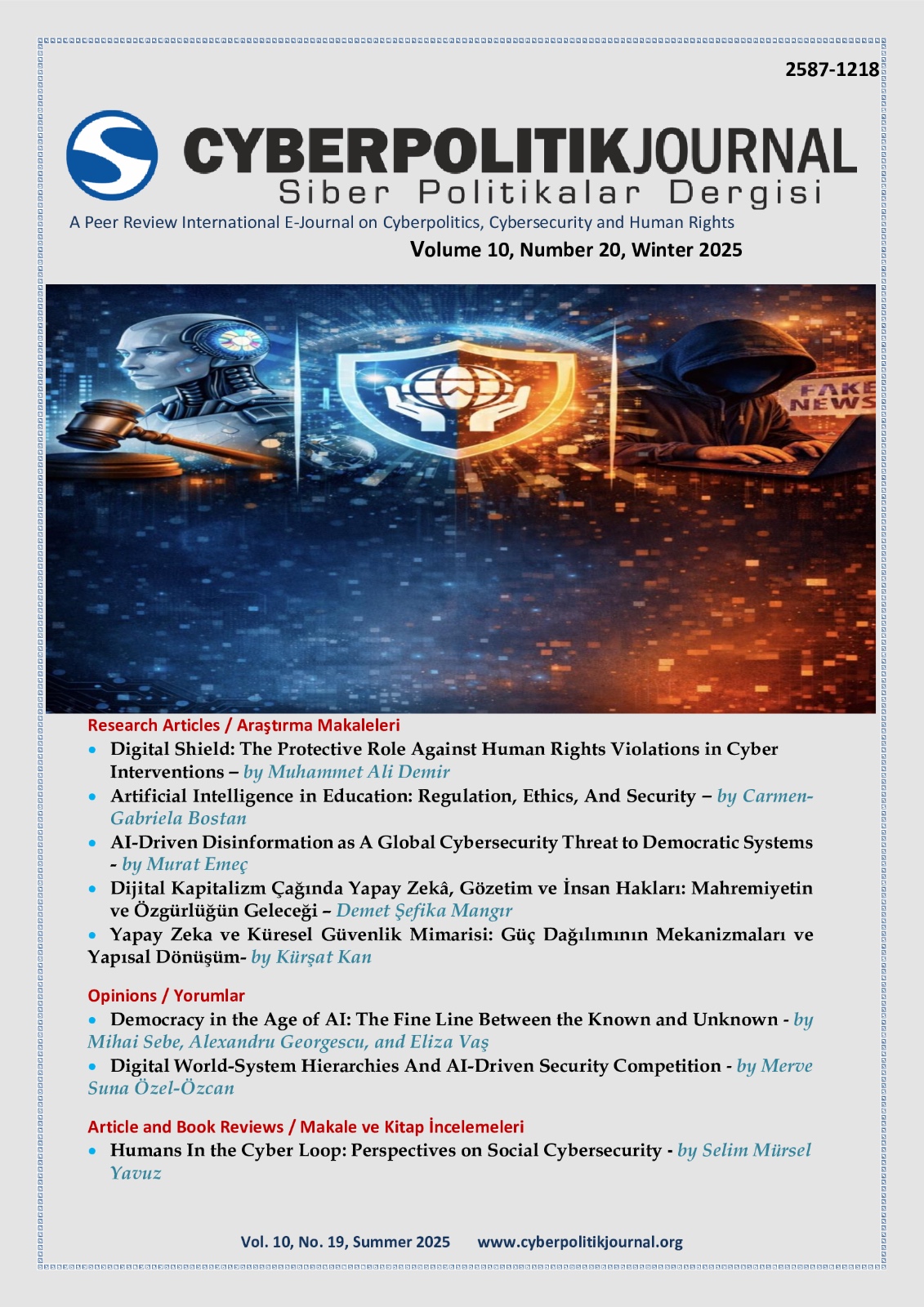
ARTIFICIAL INTELLIGENCE, SURVEILLANCE, AND HUMAN RIGHTS IN THE AGE OF DIGITAL CAPITALISM: THE FUTURE OF PRIVACY AND FREEDOM
Keywords:
Digital Capitalism, Human Rights, Digital Privacy, International Law, FreedomAbstract
In the age of digital capitalism, the protection of human rights and freedoms is becoming an increasingly critical issue in terms of both international law and global politics. With the proliferation of AI-based surveillance systems, fundamental rights such as individual privacy, freedom of expression, and data security are being redefined within the economic and political functioning of digital infrastructures. This study examines how human rights are transformed in the digital age by presenting a theoretical framework that intersects the economic logic of digital capitalism with the social impacts of surveillance technologies. Ultimately, it demonstrates that privacy laws alone are insufficient to prevent the destructive effects of surveillance capitalism and that this can only be achieved through fundamental reforms in institutional structures and international legal regulations. In this context, the study aims to contribute to global debates on digital rights, algorithmic accountability, and data sovereignty. It also aims to provide a theoretical and practical basis for policymakers and legal reformers to develop normative mechanisms that protect individual freedoms in the face of digital surveillance. Ultimately, the article presents a comprehensive assessment of the future of privacy, freedom, and human dignity in the age of digital capitalism.
References
Allen, A. L. (2008). The virtuous spy: Privacy as an ethical limit. University of Pennsylvania Law School, 1–17. https://scholarship.law.upenn.edu/faculty_scholarship/168/.
ARTICLE 19. (2018). Side-stepping rights: Regulating speech by algorithm. https://www.article19.org.
Bentham, J. (1995). Panopticon (Preface). In Miran Bozovic (ed.), The Panopticon Writings, London: Verso, 29-95.
Bygrave, L. A. (2014). Data privacy law: An international perspective. Oxford University Press.
Citron, D. K., & Pasquale, F. (2014). The scored society: Due process for automated predictions. Washington Law Review, 89(1), 1–33.
Court of Justice of the European Union (CJEU). (2014). Digital Rights Ireland Ltd v Minister for Communications and Others, Joined Cases C 293/12 and C 594/12, Judgment of 8 April 2014. https://eur-lex.europa.eu/legal-content/EN/TXT/?uri=CELEX%3A62012CJ0293.
Court of Justice of the European Union (CJEU). (2016). Tele2 Sverige AB v Post-och telestyrelsen and Secretary of State for the Home Department, Joined Cases C 203/15 and C 698/15, Judgment of 21 December 2016. https://eur-lex.europa.eu/legal-content/EN/TXT/?uri=CELEX%3A62015CJ0203.
De Hert, P., & Gutwirth, S. (2006). Privacy, data protection and law enforcement: Opacity of the individual and transparency of power. In E. Claes, A. Duff, & S. Gutwirth (Eds.), Privacy and the criminal law, Intersentia, 61–104.
Drinhausen, K., & Brussee, V. (2021). China’s social credit system in 2021: From fragmentation towards integration. Mercator Institute for China Studies (MERICS). https://merics.org/en/report/chinas-social-credit-system-2021-fragmentation-towards-integration.
Dworkin, R. (1977). Taking rights seriously. Harvard University Press. https://www.law.nyu.edu/sites/default/files/Ronald%20Dworkin%20-%20Hard%20Cases.pdf.
European Court of Human Rights. (1950). European Convention on Human Rights. Official Journal of the Council of Europe. https://www.echr.coe.int/documents/d/echr/convention_ENG.
European Court of Human Rights. (2008). S. and Marper v. The United Kingdom, Applications nos. 30562/04 and 30566/04, Judgment of 4 December 2008.
European Court of Human Rights. (2015). Roman Zakharov v. Russia, Application no. 47143/06, Judgment of 4 December 2015.
European Court of Human Rights. (2016). Szabó and Vissy v. Hungary, Application no. 37138/14, Judgment of 12 January 2016.
European Court of Human Rights. (2023). Mass surveillance – Factsheet. Press Unit. https://www.echr.coe.int/documents/d/echr/fs_mass_surveillance_eng.
Fikfak, V., & Izvorova, L. (2022). Language and persuasion: Human dignity at the European Court of Human Rights. Human Rights Law Review, 22(3), 1–30.
Foucault, M. (1977). Discipline and punish: The birth of the prison (A. Sheridan, Trans.). Vintage Books.
Gonzales, J. T. (2023). Implications of AI innovation on economic growth: A panel dataset analysis. Journal of Economic Structures, 12(1). https://doi.org/10.1186/s40008-023-00307-w
Green, B. (2022). The flaws of policies requiring human oversight of government algorithms. Computer Law & Security Review, 45, 1–22. https://ssrn.com/abstract=3921216 or https://doi.org/10.2139/ssrn.3921216.
Grundgesetz, Article 1 of the Basic Law for the Federal Republic of Germany, (1949). Federal Law Gazette I p. 1.
Guida, S., & Tozzi, D. (2020). The assessment of the proportionality of the measures that limit the privacy fundamental rights in the new guidelines of the European Data Protection Supervisor. European Journal of Privacy Law & Technologies, 2020(1), 195–207.
Harris, D., O’Boyle, M., Bates, E., & Buckley, C. (2018). Law of the European Convention on Human Rights (4th ed.). Oxford University Press.
Hildebrandt, M., & Tielemans, L. (2013). Data protection by design and technology neutral law. Computer Law & Security Review, 29(5), 509–521. https://doi.org/10.1016/j.clsr.2013.07.005.
Kilic, B., & Carr-Ryan, D. (2025). The geopolitics of surveillance capitalism [Working paper]. Harvard Kennedy School. https://www.hks.harvard.edu/sites/default/files/2025-10/25_Kilic_Tech_Paper_0.pdf?utm.
Lessig, L. (2000). Code is law: On liberty in cyberspace. Harvard Magazine. https://www.harvardmagazine.com/2000/01/code-is-law-html.
Letwin, J. (2023). Proportionality, stringency and utility in the jurisprudence of the European Court of Human Rights. Human Rights Law Review, 23(3), 478–503. https://doi.org/10.1093/hrlr/ngad014.
Lissens, S. (2024). The foundations of EU personal data protection law: Privacy and human dignity. EU-Renew. https://eu-renew.eu/the-foundations-of-eu-personal-data-protection-law-privacy-and-human-dignity/.
Lyon, D. (2017). Surveillance culture: Engagement, exposure, and ethics in digital modernity. International Journal of Communication, 11, 824–842. https://ijoc.org/index.php/ijoc/article/view/5527.
Moore, A. D. (2010). Privacy rights: Moral and legal foundations. Penn State University Press.
Nissenbaum, H. (2004). Privacy as contextual integrity. Washington Law Review, 79(1), 119–157. https://digitalcommons.law.uw.edu/wlr/vol79/iss1/10.
Özlük, D. (2023). Next stage of global capitalism: Digital platforms and rentier capitalism. Ekonomi, Politika ve Finans Araştırmaları Dergisi (EPFAD), 8(4), 681–695. https://doi.org/10.30784/epfad.1350739.
Pasquale, F. (2015). The black box society: The secret algorithms that control money and information. Harvard University Press.
Rawls, J. (1999). A theory of justice (Rev. ed.). Harvard University Press. (Original work published 1971)
Solove, D. J. (2007). The digital person: Technology and privacy in the information age. New York University Press.
Sterz, S., Baum, K., Biewer, S., Hermanns, H., Lauber-Rönsberg, A., Meinel, P., & Langer, M. (2024). On the quest for effectiveness in human oversight: Interdisciplinary perspectives. arXiv preprint, arXiv:2404.04059. https://arxiv.org/abs/2404.04059.
Waldron, J. (2010). Dignity, rights, and responsibilities (Public Law Research Paper No. 10-83). New York University School of Law.
Whitman, J. Q. (2004). The two Western cultures of privacy: Dignity versus liberty. Yale Law Journal, 113(6), 1151–1221. https://doi.org/10.2307/4135739.
Yeung, K. (2018). Algorithmic regulation: A critical interrogation. Regulation & Governance, 12(4), 505–523. https://doi.org/10.1111/rego.12160
Zuboff, S. (2019). The age of surveillance capitalism: The fight for a human future at the new frontier of power. PublicAffairs.
Downloads
Published
How to Cite
Issue
Section
License

This work is licensed under a Creative Commons Attribution-NonCommercial-ShareAlike 4.0 International License.